
The Las Vegas new construction market is going through a noticeable shift in 2026. Buyer activity has slowed, builders are adjusting their strategy, and land availability is becoming one of the biggest forces shaping what gets built next. Check out the latest data from the 2026 Las Vegas Home Builders’ Housing Outlook Conference to explain what is really happening behind the numbers.
The Las Vegas new construction market is slowing in 2026, but the slowdown is not happening for just one reason. Data from the 2026 Las Vegas Home Builders’ Housing Outlook Conference shows that buyer traffic, net sales, closings, and permits are all down compared to last year. That means fewer buyers are actively shopping, fewer are signing contracts, and fewer homes are reaching the closing table.
A major reason is affordability. Interest rates remain high, monthly payments are harder for many buyers to manage, and economic uncertainty is making people more cautious. Buyers may still want new construction homes, but many are waiting, adjusting their budget, or looking for better incentives before making a decision.
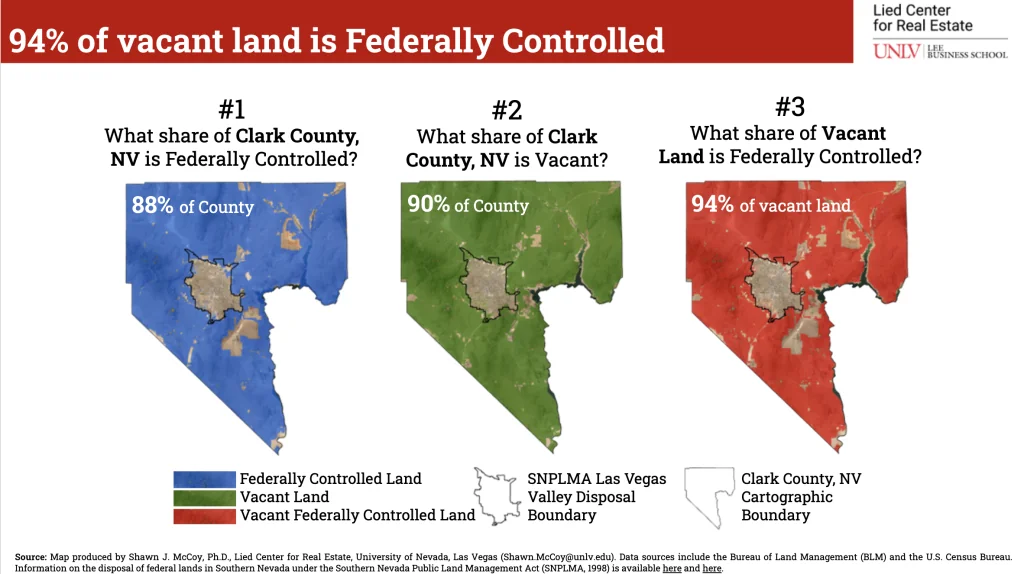
At the same time, builders are not simply pulling back across the board. New project openings are actually up, which may seem unusual in a slower market. The reason comes back to land. Large parcels are harder to secure in Clark County because so much land is federally controlled, so builders are opening smaller communities instead of massive neighborhoods with hundreds of homes.
This is why Las Vegas housing feels pulled in two directions. Demand has cooled because affordability is tight, but supply is also constrained because developable land is limited. The result is a market where builders are being more strategic, buyers are being more selective, and the type of homes being built is changing.
Compared to Q1 2025, the Las Vegas new build market is clearly softer. Buyer traffic is down 22%, with 32,298 prospective buyers recorded. Net sales are down 19%, at 2,239. Closings are also down 25%, which shows that the slowdown is moving through the full sales cycle, not just the early shopping stage.
Permits are down 20%, which suggests this slowing trend may continue. For comparison, net sales in 2016 were 2,234, very close to today’s number, but buyer traffic was much higher at 58,731. That difference says a lot. Fewer people are browsing new construction homes casually because affordability has become a much bigger hurdle.
It shows that 88% of Clark County is federally controlled, 90% of the county is vacant, and 94% of vacant land is federally controlled. In other words, Las Vegas has land around it, but most of it is not easily available for housing.
One of the few data points that increased year over year is new project openings, which are up 70%. That may sound surprising in a slower market, but it reflects how builders are adapting to smaller land parcels. Instead of large neighborhoods with hundreds of homes, many new communities now have closer to 50 homes.
Only 41.8 acres of federal land were sold last year, the lowest level since the Great Recession. This year, about 100 acres sold for $70 million. Developers also face major upfront costs, including a 20% deposit at the time of sale and full payment within 180 days.
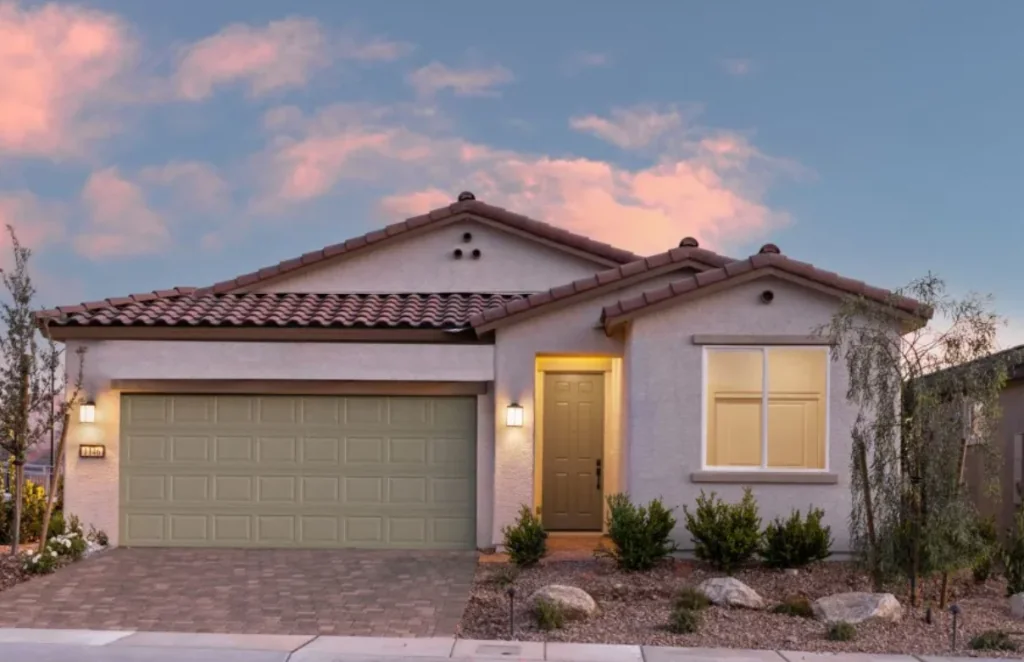
Several developments are worth watching. Aries by Pulte in Henderson, across from Lake Las Vegas, will include single-family homes and townhomes from 1,624 to 2,519 square feet, starting in the high $300Ks. The Preserve by Lennar at the former Badlands Golf Course is expected to bring 1,480 townhomes, condos, and single-family homes, with new homes expected around 2028. Centurion by Sansone Companies in Inspirada is also underway, bringing retail space, a Sprouts, and 600 apartments.
Builder performance is mixed. Lennar, DR Horton, Pulte Group, and KB remain major players, but not every builder is seeing the same results. Toll Brothers has taken one of the biggest hits, dropping from 149 sales in Q1 2025 to 77 in Q1 2026.
The only builders noted with sales increases are Sekisui House, including Richmond, Woodside, and Shawood, up 2%, and Century, up 5%.
What is actually selling? Entry-level attached homes continue to perform best. That includes condos, townhomes, and 55+ communities. The top-selling communities reflect this trend, with Sun City Mesquite at number one, Brantley by Pulte at number two, Heartland Trail by DR Horton at number three, and Touchstone’s condo projects taking the fourth and fifth spots.
Median price is down 2%, but that does not automatically mean home values are dropping. It likely reflects more attached and lower-priced product types selling.
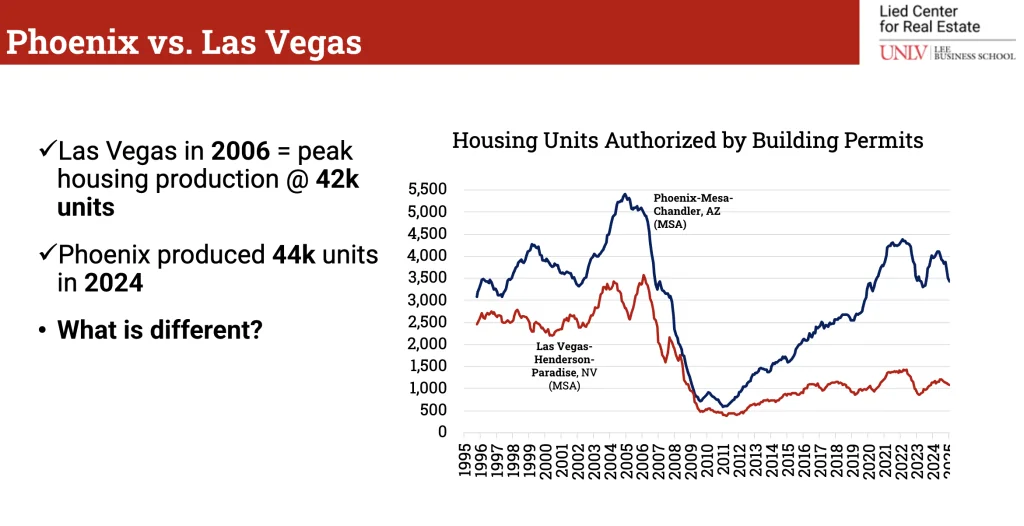
The future of Las Vegas housing looks different when compared with other fast-growing markets like Phoenix, Austin, and Los Angeles. Phoenix has been able to produce a much larger volume of new housing in recent years, with about 44,000 housing units built in 2024. Las Vegas, by comparison, reached its housing production peak back in 2006 at around 42,000 units and has not returned to that level since.
That gap matters because Las Vegas has continued to grow quickly. The metro has added more than 1 million residents since 2010, while Phoenix has added roughly 755,000 residents in that same general period. Even with stronger population growth, Las Vegas has not kept pace with Phoenix when it comes to new housing permits and large-scale development.
Austin is another useful comparison because it has been able to expand more aggressively during periods of high demand. Builders in Austin have had more opportunities to develop outward, which helped bring more new supply online. Los Angeles is different because it is already heavily built out, expensive, and difficult to develop in. Las Vegas falls somewhere in the middle. It appears to have plenty of open desert land, but much of that land is not actually available for residential development.
This is where the land issue becomes central. A large share of Clark County is federally controlled, which limits how much vacant land can be converted into new neighborhoods. So while Las Vegas may look like it has room to keep spreading outward, builders cannot simply buy and build on most of that land.
That creates a long-term supply challenge for Las Vegas housing. Demand still exists, especially with continued population growth, but builders do not have the same easy path to large-scale development that cities like Phoenix have had. Instead, many builders are working with smaller parcels, which often leads to smaller communities and fewer homes per project.
The result is a market where land availability may shape the future more than demand alone. If it cannot unlock more developable land, Las Vegas new construction could remain more limited, more expensive to produce, and harder to scale.
Are you buying, selling, or investing in Las Vegas new construction? Schedule a FREE consultation with us today!